That Cauliflower Grower's Garden
I never gave a fuck about plants or about anything green. In fact, until 8 years ago my only experience was to have killed all the plants I had ever bought in IKEA or something like this. When I was in charge, cacti longed for the moist climate of the Sahara. Having accepted my limitations, knowing how lazy I can be (let's be honest and write "I am" instead), when we bought a house in 2018 I started lobbying to replace the grass with concrete, painting it green so that the maneuver was less discrete.

By now, 8 years later, things look quite different. For example, planted on the ground, we have
- an apricot tree,
- two fig trees,
- an ichang lemon,
- a quince,
- a nashi,
- a yuzu,
- two feijoas,
- and two kinds of mandarins.


Besides that there are also a plum and an apple tree, and probably some others I am forgetting. These, although already pretty tall, have not produced yet.
There are also a few decorative trees like a bay tree or a palm tree. The palm tree was pretty small when we planted it—I carried it by bike—, and by comparison to others grows slower in height, but by now it is quite a bit taller than me. I know that this does not say much, but still... In any case, here you got a picture of the front garden now.

As you see, there are also a bunch of plants in pots. These, and all citrus trees that don't survive the winter if planted on the ground: it does not happen often, but every year there are a couple of pretty cold days here, with night temperatures like -5°C. This is one of my main frustrations because I would love to have an actual lemon tree growing large in the ground and I must do with the one in the pot... And with the ichang lemon, I guess.
Now that we are at it, here you have some pictures from the actual garden:


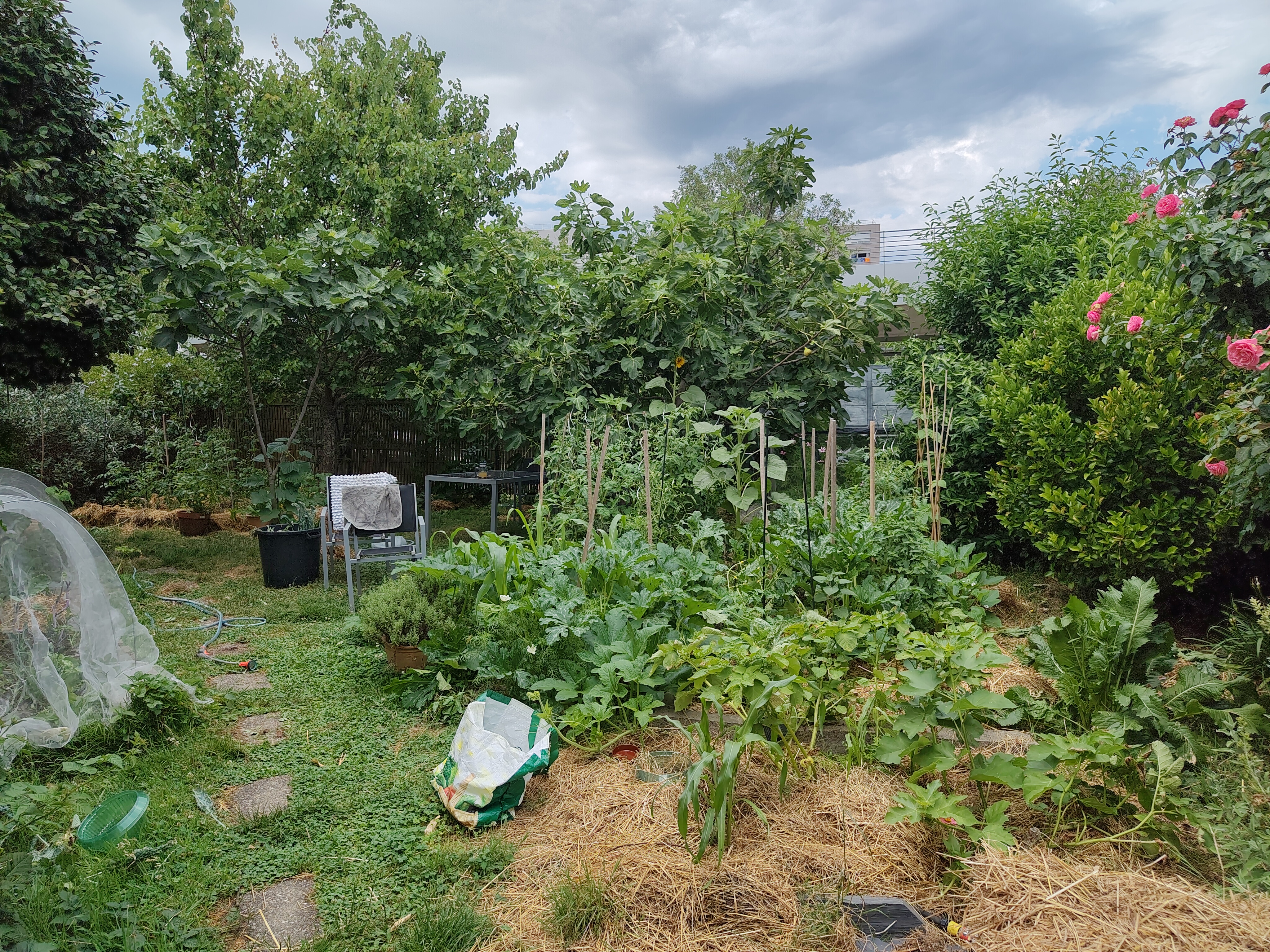
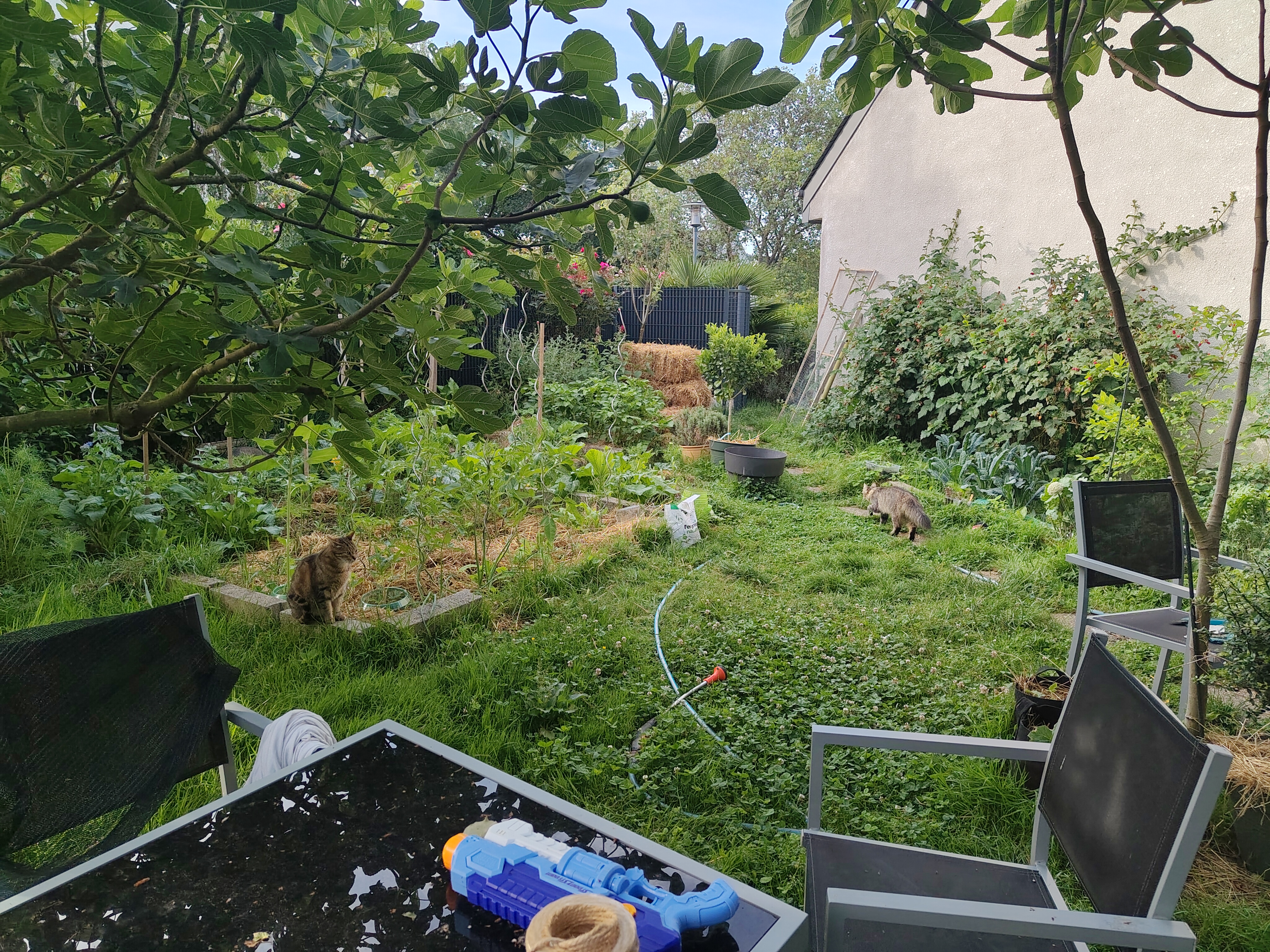


If you look carefully you will notice two things: there are a lot of cats (there are 3 in the lower right picture, and these are the ones which are not camera shy) and you see straw a bit everywhere. That straw is not only there to build piles on which the cats can be cute. In fact, it is mostly there to mulch, that is to cover the ground to prevent weeds from growing and keep humidity when it does not rain.
If you go back and look at the 2018 picture of the garden, you get an idea of the kind of neighborhood we live in: a residential subdivision with one-family houses. They were all identical when built in the 70's but by now all look kind of different. Still, a residential neighborhood. However, by public transportation (including walking) it takes 12 minutes from here to the train station and the center of Rennes. So, definitely urban.
As you can imagine, getting every year some farmer to deliver a load of bales of straw (20 or so) is not a thing in our neighborhood. Still, it happens every year and the neighbors take it without a comment. I like my neighbors.
Most of the surface is taken by what the French call le potager, which sounds much more quaint than vegetable garden. All of it is pretty much Playmobil scale, but there are truly amazing numbers of plants growing. This year there were 47 tomato plants. But there is also variety: peppers, garlic, leeks, cucumbers, melons, beans, zucchini, cavolo nero, kale, berzes, berry bushes, and so on. They are not all planted at the same time of the year, but it seems that every square centimeter is being used.


Evidently, we eat all of that. Indeed, although it is not like we don't need to buy vegetables, we quite often eat what comes from the garden. Okay, what comes from the garden, and prodigious amounts of ketchup and Nutella consumed by the smaller third of the team. Anyways, here is some of the local production:


Not everything that grows was scheduled to grow. Plants are quite resilient and even when one thinks that one has taken them out, they might well cheerily come back next year, refusing to accept their fate. Just below on the left you can see a fig tree growing under the cucumbers. We planted its great-grandfather ourselves but at some point it broke and we took it away. Or so we thought, because next year it started growing again. Since in the meantime we had decided that it was not in the right place, we took it out again. And again. And this summer the third generation of this tough fig tree is pushing through.
In the middle picture, you can also see an avocado tree that grew out of a pit—I don't remember if it grew as a science experiment or from a pit we had thrown in the compost. It dies every winter, but then it comes back. Similarly for the banana plant growing by the feijoa.


That banana plant is purely decorative (although apparently somewhere near Rennes somebody managed to get actual bananas, or at least this is what the local newspaper says. There are indeed quite a lot of "useless" decorative plants:


It might surprise anybody that knows me, but I am partial to aromatic plants. I love lavender and rosemary. In fact, it is known that if somebody were to trim that monster of a rosemary taking over our driveway, I would build a guillotine. At the end of the day, since we don't have a car, we do not really need the driveway... Also, rosemary is useful in the kitchen, as are herbs like sage, thyme, tarragon, or mint. What I also use, and find amazing that grows in our garden, is Sichuan pepper.


When we first started taking care of the garden, we bought a lot of plants and trees. We still do, but that proved expensive. So, now the plants are grown from seeds. That means that all the time there are myriads of small pots with seedlings growing. In the summer it is not hard to find space for them, but in the winter they take over the house. Even the most unexpected places like the top of the bathroom cupboard:


And well, how is this possible that all of this grows in our garden. As I mentioned, this year there were 47 tomato plants...
Well, the answer has two legs:
- The density is enormous. Said differently, 9 inches sometimes means 9 cm. Hard to believe.
- Many plants get consumed by the other inhabitants around here.
Butterflies seem to really like fresh cabbage, and that's why some of the plants are protected by netting, which, given the times we are living in, is reminiscent of anti-drone mesh, but this one just has to stop things that weigh 0.5 grams. To protect plants from bad weather we also got a small greenhouse, where now there are growing tomatoes (what else?), jalapeños, and herbs.


Now, if you made it this far and you remember that my first intention was to concrete the garden over and paint it green, you might be thinking that I have changed, that I've turned a new leaf, that I did a total 180°... Well, you would definitely have a point, because I have had something to do with all the transformation of the garden. But it is clear that most of the merit is due to whom we are going to refer to as the cauliflower grower. The cauliflower is pictured on the right, and the hand you are seeing is the grower's... In the other picture you have a different view of the grower's hand, this time holding a unique torus shaped tomato.
I guess that the grower is as camera shy. As are some of the cats. But in any case the name cauliflower grower fits perfectly. At least in my opinion. And at the end of the day it is me who is writing this. It is also because of that I don't feel the slightest guilt for, when writing the above, having taken more credit than I deserve. If the cauliflower grower objects, let her write her own version... And I want to point out that I could start tobbying for torus tomato grower, which evidently does not have the same ring.
To conclude, a few more pictures I like:


